Back to Blog
2026-09-05
12 min read
The parent finally has a verb. The book still will not say how many minutes.
At v0.5.0 the saucier record for Mornay said it derives from Béchamel and stopped there, two lines above the sentence that says how. v0.6.0 records that sentence for one preparation, by hand, as six operations in the book's own words, with every number the text gives and every one it withholds left empty. The check that refuses a misquote also turned up the first confirmed difference between the 1907 and 1909 printings.
Here is what saucier show mornay printed at v0.5.0, cut to the two lines
that matter:
The record says Mornay derives from Béchamel. The sentence underneath, at line 2439 of the 1909 text, two lines below the heading of entry 91, says what is done with the Béchamel, and the record does not read it. The Marrow Sauce post spent two and a half thousand words getting the parent edge right, and the edge it got right is an input with the operation stripped off. A parent says what a sauce is built from. It does not say boil, reduce, or finish, and it does not say how much or how far.
v0.6.0 reads that sentence, for one preparation, by hand. The census does
not move: 151 sauces, 57 derived, 94 unresolved in the 1909 text, and 140,
50, 90 in the 1907 scan, the same census as
the stream post, whose
151 and 140 these split. What moves is the record underneath one of them.
Six operations, in the book's order
And the eight lines it was read from, lines 2439 to 2446 of the committed corpus, exactly as Project Gutenberg transcribed them:
Boil one pint of Béchamel Sauce with one-quarter pint of the fumet of the fish, poultry, or vegetable, which is to constitute the dish. Reduce by a good quarter, and add two oz. of Gruyère and two oz. of grated Parmesan.
Put the sauce on the fire again for a few minutes, and ensure the melting of the cheese by stirring with a small whisk. Finish the sauce away from the fire with two oz. of butter added by degrees.
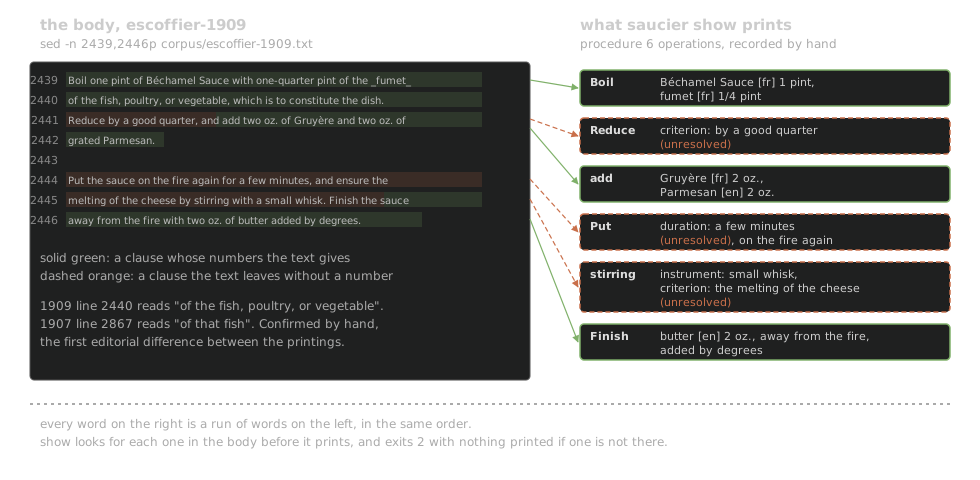
Every line on the right is a run of words on the left. Boil takes two
inputs, each with the quantity the text gives: one pint, one-quarter pint.
Reduce takes nothing and carries a criterion, the words the reduction is
carried to. add takes two cheeses at two ounces each. Put carries a
duration and a constraint, on the fire again. stirring carries an
instrument and a criterion. Finish takes the butter and two constraints,
away from the fire and added by degrees. That is the whole entry, and
nothing in it is inferred.
ADR-0017
is the record of the shape, and the glossary gains ten terms for it,
because this project uses one word per thing and this release needed ten
new things: procedure, operation, wording, input, parameter, criterion,
constraint, instrument, recorder, unrecorded.
Three slots the text left empty
Look at the three (unresolved) marks. Béchamel gets 1 pint. Gruyère
gets 2 oz.. The reduction gets by a good quarter, and no number. The
return to the fire gets a few minutes, and no number. The stirring gets
the melting of the cheese, which is a criterion with no number in it at
all.
That is deliberate, and it is the same rule this series has applied to
parents since the first post.
A parameter holds the words, the number the words give, and the unit they
name. one-quarter pint records the fraction one over four and the unit
pint. a few minutes records the unit minutes and no number, because the
text gives none. by a good quarter names a degree and not a quantity, so
it records no number either. No code fills the slot. Anyone who has cooked a
Mornay knows roughly how many minutes "a few" is, and a model would happily
write 3. The parser writes nothing, because Escoffier wrote nothing, and
the moment this record holds a number the book does not the record stops
being the baseline a model has to beat.
The stream post argued that null in a parent field means the source
declined to state one, never that the sauce has none. This is the first
time the same absence is recorded against something other than a parent. A
duration with no number is a fact about the text.
The record cannot say what the entry does not
The six operations are Python literals in an adapter, written by hand against lines 2439 to 2446. A hand can misquote. So the command never prints a procedure it has not first found in the body.
Each operation carries its wording, the whole clause it was read from.
Each input, criterion, duration, and constraint carries its own wording, and
the entity refuses an element whose words do not lie inside its operation's
wording.
Then, before show prints anything, it collapses whitespace on both sides
and looks for each operation's wording in the body, in order, each one
after the last. An operation the body does not carry, or carries out of
order, is reported, and the command exits 2 with nothing on standard
output:
The first version of this printed the title, the reference, the terms, and
the parent before it ran the check, so a piped reader got half a record and
then a non-zero exit. Review caught it, and the check now runs before the
first byte. The stream post's first reader accepted a file missing its last
line. This release's first show printed half a preparation beside a
refusal. Same lesson, one layer up: a check that runs after the output has
started is a comment.
What the check proves is narrow, and the ADR says so. It proves the words
are there and in that order. It does not prove the reader parsed the clause
correctly. Three choices in the Mornay record are the reader's, and they
are written down so a disagreement has something to point at. ensure the melting of the cheese by stirring with a small whisk records the verb as
stirring, with the melting as the criterion and the whisk as the
instrument. the sauce and the cheese name the preparation in progress
and are not inputs. Put the sauce on the fire again names no heat, so no
heat is recorded.
The scan keeps its verb and loses its parent
The 1907 witness carries the same entry at line 2864, and the release records a second procedure for it, in the scan's words, because a procedure quotes its witness and the two witnesses do not read alike:
The heading reads MORN AY SAUCE, so show mornay finds nothing in the
scan. The first input reads Bdchamel Sauce, whose folded form reaches no
catalogued name, so the scan's Mornay has no parent and no candidate. The
text resolves it. The verb is on the record in both. Gruy^re stays
Gruy^re, and the Reduce clause carries the running page header 40 GUIDE TO MODERN COOKERY inside its wording, because the scan carries it there
and ADR-0013
repairs the punctuation that delimits a record, never the characters inside
one. The Périgueux page break from the stream post is the same running header,
ten pages earlier, doing the same damage.
The one difference that is not the scanner
The second-copy post
ended on a sentence I have repeated in every post since: not one confirmed
editorial difference between the 1907 and 1909 printings. Every candidate
was the scanner or the reader. The README said so at v0.5.0.
Writing the 1907 procedure by hand meant reading line 2867 of the scan
against line 2440 of the text, word by word, because the check would refuse
anything else. The fumet is of that fish which is to constitute the dish
in 1907. It is of the fish, poultry, or vegetable, which is to constitute the dish in 1909. No scanner adds two nouns and three commas. Between the first
printing and the revised edition the sentence widened, from fish to fish,
poultry, or vegetable. Whose hand widened it, the two texts do not say.
That is one difference, confirmed by hand, on two lines anyone can open.
The diff command has still confirmed none, and the README now says exactly
that: the diff has confirmed nothing, and one difference has been confirmed
by a reader with both texts in front of them. It took recording a
procedure to find it, because a procedure quotes the witness and a parent
only names it. bechamel is the same concept in both books. of that fish and of the fish, poultry, or vegetable are not the same words.
What I am not claiming
One preparation is recorded, once per witness, and a test pins the count
at one. Two procedures written by hand is not extraction. The rule that
would read a second one out of an entry does not exist yet, and until it
does the count stays where it is. What does exist is the port the hand
record enters through, and the line recorded by hand in the output is
the recorder naming itself. A rule reader, or a model, is another
implementation behind the same port, and whatever it records will say who
read it. Cardinal Sauce, entry 69, still boils
Béchamel and finishes with lobster butter and still records no parent,
because two catalogued names sit in its opening paragraph and
a resolver may refuse, never rank.
The verb that would tell those two names apart, one boiled and one added at
the finish, is exactly what a procedure carries. Reading it by rule is the
record after this one, and the ten sauces
the line-1437 post
lost to a butter are waiting on it.
The procedure is not stored and the interchange does not carry it. show
fetches it beside the preparation, checks it, and prints it. The JSON files
under data/ did not change, saucier/1 did not change, and a consumer of
the stream sees no operation.
ADR-0016
says a new field earns a new schema version, and one preparation does not
earn one.
And the parent field is untouched. The procedure sits beside it and never
writes it. Mornay's first operation boils Béchamel, which is its parent, and
that agreement is a check on the resolver, not a replacement for it.
Everything here reproduces from the tag:
Six operations, five quantities the book gives, three it withholds, and one sentence Escoffier changed between two printings. If the record says something lines 2439 to 2446 do not, or reads one of the three choices above differently than you would, the issue template asks for the entry number and the source lines. Line 2440 is where I would start.
The release: saucier v0.6.0
— the first recorded procedure: saucier show mornay prints six operations in
the book's own words, five quantities the text gives and three it withholds
left unresolved rather than guessed, every word checked against the source
before it prints. MIT.