Back to Blog
2026-09-04
10 min read
I cut the last sauce off the file. Every line still parsed.
saucier now writes both copies of Escoffier as one stream, one record per line, so a shell can read the catalogue without importing my package. The first reader I wrote for it accepted an empty file, then a file missing its last sauce, with every remaining line valid JSON. Then a jq one-liner over the stream found a Périgueux the scan resolved and the text refused.
I deleted the last line of a 293-line file and fed the rest to a reader I had written for it that week. It rebuilt two catalogues, printed a census one sauce short, and exited zero. Every line it read was valid JSON. The line I had deleted was the scan's Strawberry Sauce, entry 2417 of the 1907 text, at line 41807, and nothing in the stream knew it was gone.
The file exists because, after
the line-1437 post,
I wanted one list: every sauce that sits on half glaze, in both copies of the
book, side by side, asked from a shell and not from inside my own package. I
could not ask. The catalogue was two JSON files, one for each copy of the
book the project reads, and their shape was whatever my dataclasses were on
the day they were written. So v0.5.0 adds two commands. saucier export
prints both catalogues to standard output as one stream, one complete JSON
record per line. saucier import --check reads that stream back, rebuilds
every catalogue in memory, prints the census, and writes nothing. The JSON
files stay as they were, and parse, show, tree, and diff do not know
the stream exists.
One line, one record
Line 9 of the export is entry 25 of the 1909 text, the sauce Escoffier prints at line 1467:
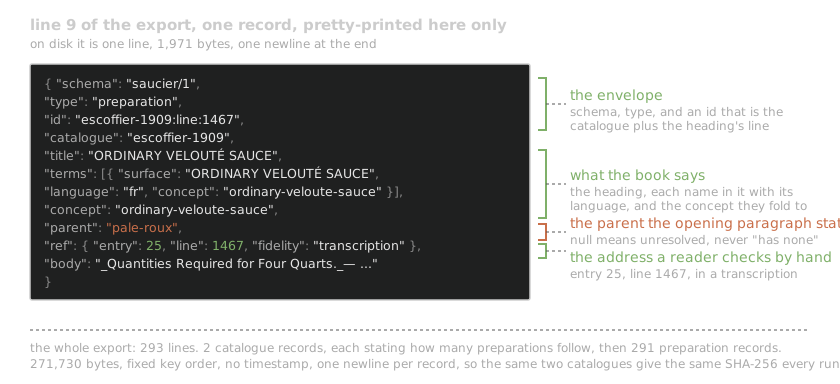
Every line says what schema it follows, what kind of record it is, and which catalogue it belongs to, so a line can be read on its own. The two catalogue records come first, and each states how many preparations follow it.
Every line still parsed
Delete the last line of the export and feed the rest to the reader:
The first reader I wrote rebuilt two catalogues, printed the census with the scan at 139 sauces instead of 140, and exited zero. Every line that survived was complete JSON, and my reader asked nothing of the stream except that each line parse.
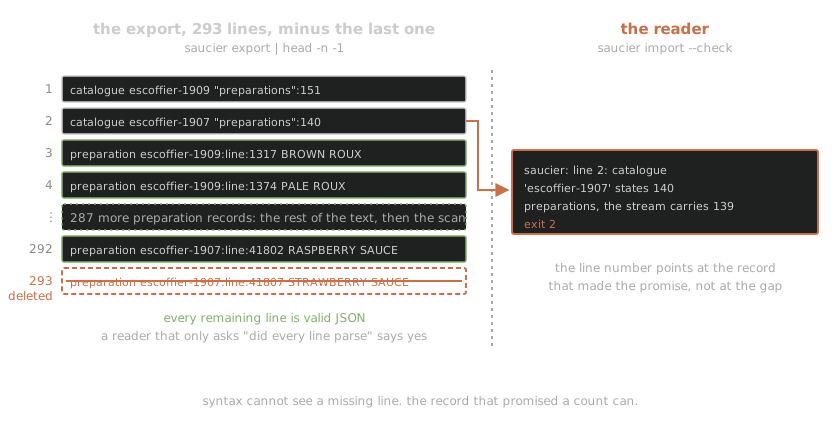
That is why a catalogue record states how many preparation records belong to it. The reader counts them in, and the line number in its refusal points at line 2, the record that made the promise, not at the gap. The count was not in the stream until a review deleted a line and the reader said nothing. It was the second of three things a stream of well-formed records could lie about and the first reader could not see.
| what the stream did | the first reader | the reader at v0.5.0 |
|---|---|---|
| arrived empty | rebuilt nothing, exit 0 | interchange carries no catalogues, exit 2 |
| lost its last line | census one short, exit 0 | line 2: ... states 140 preparations, the stream carries 139, exit 2 |
repeated parent on line 9 | Velouté moved to unresolved, exit 0 | line 9: object repeats a key: ['parent'], exit 2 |
The empty stream matters because of the pipeline the command exists for,
saucier export | saucier import --check. Without pipefail a pipeline
reports its last command's exit status. If the export died before writing a
byte, the first reader saw an empty stream, accepted it, and the pipeline
would have finished with exit zero and the failed export behind it.
The repeated key is a property of Python's JSON parser, which keeps the last
value of a duplicated key and says nothing. Append a second "parent":null
to line 9 and an ordinary decoder moves Velouté from derived to unresolved
with the census off by one and nothing raised. The reader still uses the
standard parser but gives it a hook that watches the keys arrive and refuses
a repeat. Nobody found that one. I went looking once the first two had taught
me to.
The one-liner, and the Périgueux row
Now the list I wanted, in one line of jq that imports nothing of mine:
Arranged into two columns:
| escoffier-1909, the text | escoffier-1907, the scan |
|---|---|
| line 1680 SAUCE BORDELAISE | line 2057 SAUCE BORDELAISE |
| line 1708 BROWN CHAUD-FROID SAUCE | line 2085 BROWN CHAUD=FROID SAUCE |
| line 1750 DEVILLED SAUCE | line 2132 DEVILLED SAUCE |
| line 1841 ITALIAN SAUCE | line 2233 ITALIAN SAUCE |
| line 1874 LYONNAISE SAUCE | line 2268 LYONNAISE SAUCE |
| line 1886 MADEIRA SAUCE | line 2280 MADEIRA SAUCE |
| line 2314 PERIQUEUX SAUCE | |
| line 1930 PIQUANTE SAUCE | line 2327 PIQUANTE SAUCE |
| line 1994 ROBERT SAUCE | line 2398 ROBERT SAUCE |
Eight sauces in the text, nine in the scan, and two rows that are findings.
BROWN CHAUD=FROID is the scanner reading a hyphen as an equals sign at line
2085, and it stays as recorded:
ADR-0013
repairs the punctuation that delimits a record, never the characters that
constitute one, and = is inside the title.
The unpaired row is the one I care about. In the 1909 text Périgueux refuses to resolve, because its opening paragraph names two catalogued sauces, half glaze and Madeira, and the resolver may refuse but never rank. The scan records half glaze, confidently. Same sentence, same two names, and a page break between them:
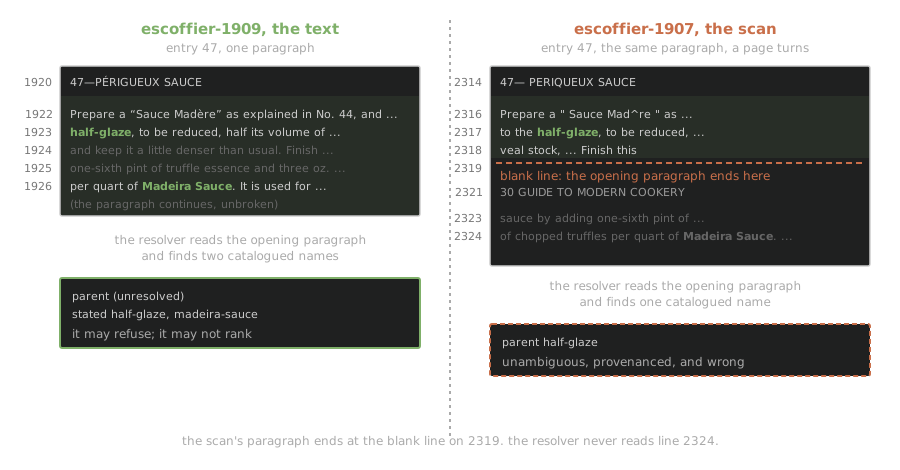
The resolver reads the opening paragraph only. In the scan that paragraph
ends at the blank line on 2319, the running header sits on 2321, and "per
quart of Madeira Sauce" is on 2324, outside what the resolver reads. One
name left, so it answers. That is the Aurore shape from
the second-copy post,
where a damaged witness resolves what a clean one honestly cannot, and the
line-1437 post already counted Périgueux among three rows of it. What is new
is where I was standing when I saw it: in a shell, with a stream and jq.
grep -c '"parent":null' on the same stream says 184, which is the 94
unresolved sauces of the text and the 90 of the scan.
What I am not claiming
This stream is not a database. It indexes nothing, keeps no history, and answers no question about the graph of sauces. The JSON snapshot is still the working store behind every other command, and the stream carries records between processes and stops there. It is also less of a stream than the word suggests: the reader consumes one line at a time, but a catalogue is validated whole, so rebuilding one holds all of its preparations in memory first.
Two exports cannot be concatenated, because each carries every configured
catalogue and the reader stops at line 294 pointing back to line 1. A
catalogue id is a source id, which names a work and an edition, so two scans
of one printing would collide on every id. saucier/1 carries one catalogue
per source id and does not pretend the identifiers can tell those texts
apart.
ADR-0016
records those limits and why the interchange is not the store.
And there is nothing here about what Escoffier changed between 1907 and 1909. The Périgueux row is a fact about a page header and a resolver that reads one paragraph, surfaced from a shell.
Everything here reproduces from the tag:
The first pipeline prints 151 sauces and 140, then 2 catalogues and 291 preparations rebuilt. Nothing written. The second stops at line 2. Between
them is a 293-line file that anyone with jq can ask about half glaze, and
that lists a Périgueux the scan resolved and the text refused. If you can
find a line in that stream that lies about the book and the reader lets
through,
the issue template
asks for the entry number and the source lines. Line 2314 of the scan is
where I would start.
The release: saucier v0.5.0
— the stream and the reader that refuses it: saucier export writes both
witnesses as saucier/1 records, 293 lines to the same SHA-256 every run, and
saucier import --check rejects the empty file, the truncated one, the
repeated key and the rest, each with the line number where there is a line to
name — the empty stream has none. MIT.