Back to Blog
2026-09-03
16 min read
The book spells it out at line 1437. Two of my posts said it never did.
Two earlier posts said Escoffier never spells out that half glaze is a reduction of Espagnole. Entry 23 does, in its first sentence. This is the clause of my own that hid it, the 27 entries that enter when it goes, and the ten derivations the release gives back on purpose.
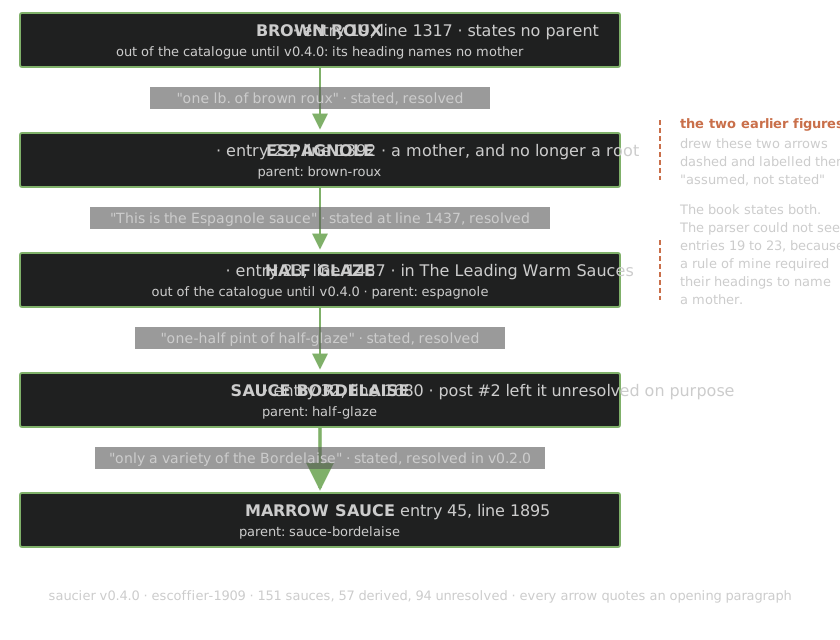
Two earlier posts in this series carry a figure of the same four sauces: the one where ice cream got into the catalogue, and the one where Marrow Sauce finally got a parent. At the top of that figure is Espagnole. A dashed arrow runs from it down to half glaze, and the arrow is labelled assumed, not stated — half glaze, the caption says, is "a reduction of Espagnole the book never spells out." The Marrow Sauce post goes further in prose: a demi-glace is an Espagnole reduction, "which every reader of Escoffier knew and the book therefore never says."
saucier is a parser that reads Escoffier's 1909 Guide to Modern Cookery and records only what the book states. Here is entry 23 of that text, at line 1437, in the chapter Escoffier titles The Leading Warm Sauces:
HALF GLAZE. This is the Espagnole sauce, having reached the limit of perfection by final despumation. It is obtained by reducing one quart of Espagnole and one quart of first-class brown stock until its volume is reduced to nine-tenths of a quart.
The book says it. It says it in the first sentence of a numbered entry, in the sauce chapter, nine entries before Bordelaise. I published two posts and two figures asserting the book never says it, because my parser could not see entry 23, and I believed my parser over the book.
The parser could not see it because the rule that decides what counts as a
sauce had two tests, and the second could overrule the first. This release
deletes the second test. Here is what that does to the census at v0.4.0:
At v0.3.0 the 1909 line read 124, 50, 74. Twenty-seven sauces entered.
Unresolved rose by twenty, and every one of the twenty is something the
parser could not see before: an entry my rule hid, or an ambiguity that was
invisible while the entry was hidden. The honest number got worse because the
instrument got better. And derived rose by seven, which is the misleading
number, for the best reason in the release.
The clause that vetoed Escoffier
Escoffier opens the chapter at line 1246 by saying what his sauces are:
Warm sauces are of two kinds: the leading sauces, also called "mother sauces," and the small sauces, which are usually derived from the first-named, and are generally only modified forms thereof.
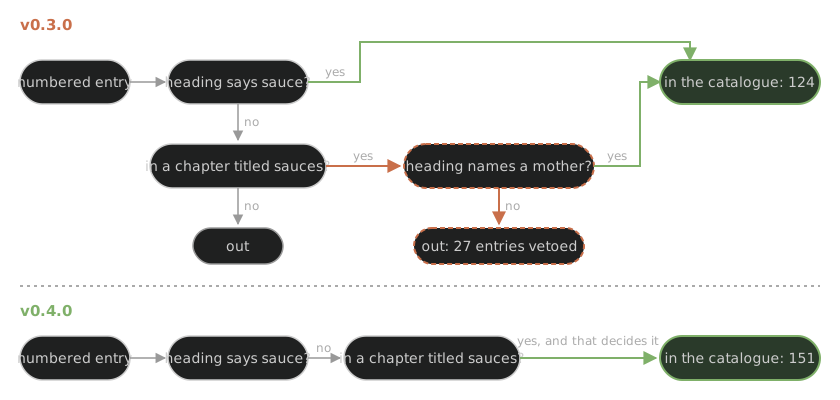
The ice cream post introduced ADR-0007: the source decides what counts as a sauce, because deciding for ourselves is what put vanilla ice cream in the catalogue. Under that record an entry enters on two kinds of evidence. Its heading says "sauce". Or the source filed it in a chapter Escoffier titles as sauces — and its heading also names one of the five mothers.
That second test has two clauses. The chapter clause reads the source's own classification. The mother clause adds a test of mine on top of the reading, and when the two disagree, mine wins. A second test on a classification the source has already made is a veto, not a check.
I wrote the mother clause to keep LENTEN ESPAGNOLE and VELOUTÉ DE VOLAILLE, two derivatives in the sauce chapters whose headings never use the
word. It kept them.
ADR-0015
counts what it cost, in the three sauce chapters of the 1909 text:
| entries | |
|---|---|
| numbered entries in the three sauce chapters | 139 |
| heading lacks the word "sauce" | 29 |
| admitted on the mother clause | 2 |
| vetoed | 27 |
The 27 are the three roux, half glaze, two gravies, a lobster method that Escoffier numbered as its own entry, whisked mayonnaise, various cullises, and 18 compound butters from the chapter titled Cold Sauces and Compound Butters. Every one of them is an entry the source classified. My rule classified them again and lost.
Here is what that looked like on screen, at v0.3.0:
The record and the sentence that contradicts it, four lines apart, for three releases. Eleven sauces name half glaze in their opening paragraph. Five name a roux. The book writes the chain in full — brown roux, Espagnole, half glaze, Robert — and the catalogue had dropped the middle link.
The new rule is one sentence: an entry inside a sauce chapter qualifies on the chapter, and an entry outside one qualifies on its heading alone. The function that decides admission went from five lines to one:
The mothers are still read, for the catalogue and for resolution, and they
take no part in admission. Nothing is hand-excluded to make the result tidy:
VARIOUS CULLISES is entry 144, numbered inside a sauce chapter, and it is in
the catalogue now. An admitted entry that reads oddly as a preparation is a
finding, not a special case in the parser.
Twelve gained, and one of them was the bar
With half glaze and the roux in the catalogue, the chain resolver from the Marrow Sauce post has something to resolve against. Twelve sauces now record the parent Escoffier wrote, and none of them needed a new rule to do it:
| resolves to | sauces |
|---|---|
| half glaze | Bordelaise, Brown Chaud-froid, Devilled, Italian, Lyonnaise, Madeira, Piquante, Robert |
| brown roux | Espagnole |
| pale roux | Velouté |
| white roux | Scotch Egg |
| manied butter | Mousseuse |
Bordelaise is on that list, and the Marrow Sauce post made a point of Bordelaise. Its opening names half a pint of half glaze and never says Espagnole, so it stayed unresolved — "not a gap in this release," I wrote, but "the bar the model post will have to clear." The bar is cleared, and no model cleared it. A chapter test cleared it, by letting the resolver see an entry that was in the book the whole time.
That heading line is new. Escoffier names five mothers, and that does not change. But Espagnole opens with "one lb. of brown roux dissolved in a tall, thick saucepan with six quarts of brown stock," and the catalogue can now see the roux, so a mother may state a parent. It cannot see the stock: brown stock is entry 7, in Fonds de Cuisine, a chapter Escoffier does not title as sauces. The chapter decides, and Chapter I decided stocks.
Ten lost, and they are the finding
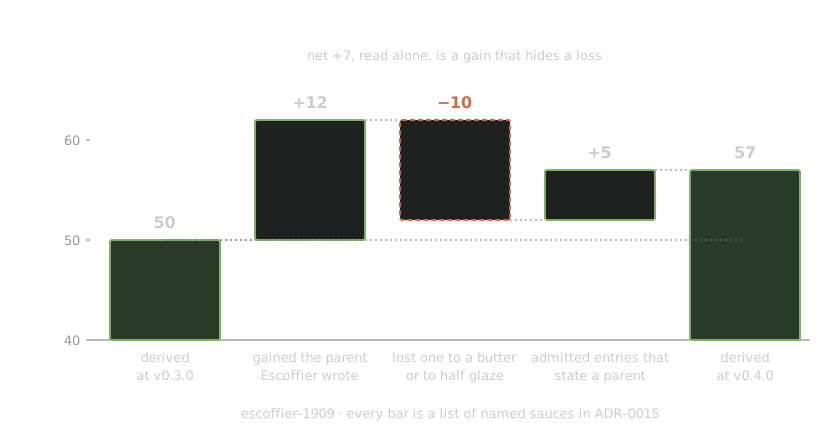
Derived rose from 50 to 57, and seven is three numbers: twelve sauces gained
a parent, five admitted entries state one of their own, and ten sauces that
were resolved at v0.3.0 are unresolved now. Eighteen of the 27 admissions
are compound butters, and seven of the ten losses are sauces that now see a
compound butter beside their old parent. The butters that came in are the
butters that took Cardinal's parent away.
Here is Cardinal, which is the shape of all ten, with a line that did not
exist at v0.3.0:
And the paragraph beneath it, with the two verbs the resolver cannot read:
Boil one pint of Béchamel, to which add one-half pint of fish fumet and a little truffle essence, and reduce by a quarter. Finish the sauce, when dishing up, with three tablespoonfuls of cream and three oz. of very red lobster butter (No. 149).
At v0.3.0 Cardinal recorded bechamel, and that was correct. Lobster
butter was on the page then too, at entry 149, but the mother clause had kept
it out of the catalogue, so as far as the resolver could see it was an
ingredient with no entry. Now it is catalogued, the opening paragraph states
two catalogued names, and
ADR-0012
says what happens then: the resolver refuses. It may not rank. So Cardinal is
unresolved, and so are Nantua, Noisette, Diplomate, Joinville, Herb and
Ravigote, each with at least one butter beside its old parent. Périgueux,
Reform and Chasseur lose theirs the same way to half glaze, which now sits
beside the base each of them names.
The refusal is correct under the rule as written, and the rule as written is wrong about this sentence. The source stated one base and one finish. Any cook reading the paragraph knows which is which. The resolver reads names. It cannot tell a base from a finish, because it has never been asked to read the verb a name sits inside — and until it can, the honest answer is the refusal.
I could recover all ten this afternoon. A rule that prefers a mother when one is stated would put Cardinal back on Béchamel and the derived count back near 67. I am not doing it, and the reason is the second-copy post's Aurore sauce. The candidate rule is not tuned to save the number. Every tuning of it that saves Cardinal is a choice made by me rather than a statement made by the book, and the whole value of the unresolved count is that it has never contained one of those.
What the release does instead is make the refusal readable. That stated
line names every catalogued candidate the opening paragraph states, in the
order the paragraph states them. The adjudication this tool cannot perform
still exists only in me. But the evidence I would adjudicate from is now on
screen next to the refusal, which is the most the parser is entitled to do.
One of the twelve gains belongs in this section too. MOUSSEUSE SAUCE
resolves to manied butter, because its opening calls for "one-half lb. of
stiffly-manied butter" and manied butter is now a catalogued entry. The
same paragraph continues: "This preparation, though classified as a sauce,
is really a compound butter." Escoffier classified it as a sauce and said in
the same breath that the classification was a courtesy. The catalogue reads
the chapter and records the sauce. The reader reads the sentence and knows
better. It stays as recorded. I would rather carry a visible oddity than an
invisible rule.
What it did to the scan
The 1907 witness moves from 115 sauces, 36 derived, 79 unresolved to 140, 50,
90. Twenty-five entries entered, not 27. MONTPELLIER BUTTER is on the page
at line 3782 of the scan, and HAZEL-NUT BUTTER at 3816:
IS3 for 153, 15s for 155. The entry pattern wants digits and never
matches, so both sit inside the 284-entry blind spot the second-copy post
measured. Repairing them means deciding that S is 5 from outside the
document, and
ADR-0013
makes no such decision.
The scan also reads two entry numbers twice, 138 and 63, and until this release the catalogue used the number as a preparation's identity, so the later entry's bookkeeping overwrote the earlier one's. A preparation is now identified by the line its heading sits on, which is unique in both witnesses and is the field a reader checks by hand.
The diff moves from 9 unmatched, 18 parent-changed, 35 ocr-suspected to 11,
19, 36. Three of the new rows are the Aurore shape again: HERB, RAVIGOTE
and PÉRIGUEUX state two candidates in the proofread text and refuse, the
scan hides one candidate in each, and the scan answers. A damaged witness
confidently resolving what a clean witness honestly cannot was described once
as a finding. It has now happened four times.
Worse than the scanner, in one specific way
The second-copy post gave this series its second rule, observed, never assumed, and wrote it down as ADR-0014: a damaged witness cannot establish absence.
I wrote that record about a scanner. Ten days later the same failure turned up on the clean witness, in a proofread transcription with no OCR damage anywhere in it. The blind spot was a clause I wrote, and the absence it produced went into two posts, two figures, and the published claim that the book never spells out what it spells out at line 1437. The project had 243 tests when I found it, and every one of them was green.
The scan's blind spot could be measured, because there was a clean witness to measure it against. The mother clause's blind spot had no second witness to reveal it, because both copies of the book went through the same rule.
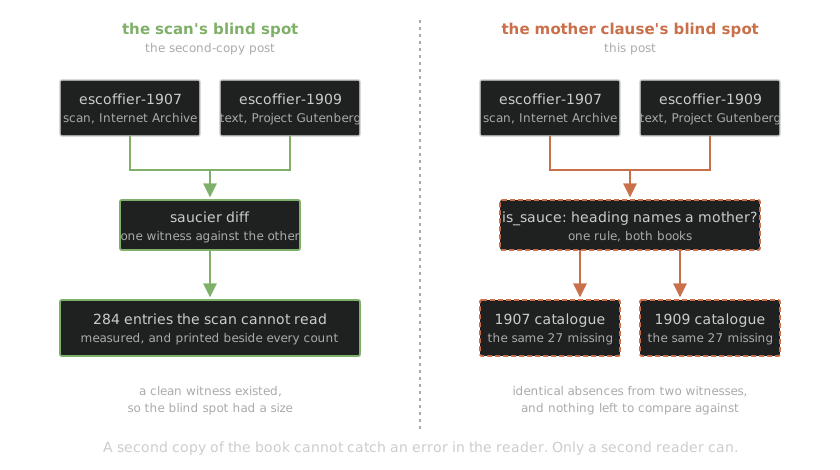
A second copy of the book cannot catch an error in the reader. Only a second reader can, and the second reader here was a person following the chain Robert states, by hand, and asking why the middle of it was not in the catalogue.
Both earlier posts now carry a dated note beside their figure. The figures are left as printed, because what they show is genuinely what the parser recorded at those tags. What they say about the book was wrong.
What I am not claiming
Not one of the ten lost derivations is a finding about Escoffier. Every one is a finding about a resolver that reads names and not verbs. And the 27 admitted entries are a claim about where Escoffier put them, not about what a sauce is — if a lobster method numbered as its own entry in the sauce chapter is not a sauce, the argument is with the book's table of contents.
Everything here reproduces from the tag:
That prints 151 sauces and 140, the chain from brown roux to Robert that the
book has always written in full, and a stated line under Cardinal naming the
two things it says, in the order it says them. If you can tell me a rule that
reads "finish the sauce with" as a finish and not a base, without reading
anything the sentence does not contain,
the issue template
asks for the entry number and the source lines. Entry 69, line 2192 is a
good place to start.
The release: saucier v0.4.0 — the mother clause deleted: the second test is the chapter clause alone and the heading test still stands beside it, the 27 entries Escoffier filed among his own sauces come back, ten derivations are given up on purpose, and a preparation is identified by the line its heading sits on rather than by an entry number the scan reads twice. MIT.